脱氧核糖核酸(英语:Deoxyribonucleic acid,缩写为DNA)又称去氧核糖核酸,是一种分子,可组成遗传指令,以引导生物发育与生命机能运作。主要功能是长期性的资讯储存,可比喻为“蓝图”或“食谱”[1]。其中包含的指令,是建构细胞内其他的化合物,如蛋白质与RNA所需。带有遗传讯息的DNA片段称为基因,其他的DNA序列,有些直接以自身构造发挥作用,有些则参与调控遗传讯息的表现。
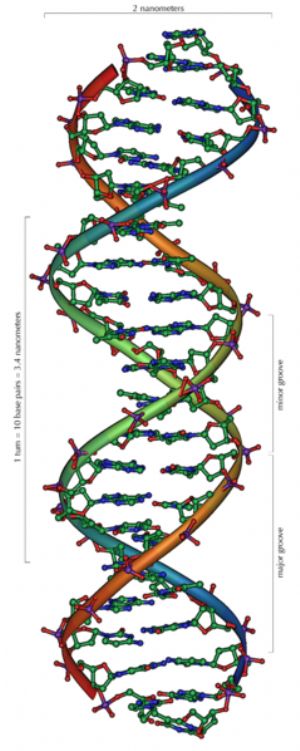 |
| DNA双股螺旋。 |
DNA是一种长链聚合物,组成单位称为核苷酸,而糖类与磷酸分子借由酯键相连,组成其长链骨架。每个糖分子都与四种碱基里的其中一种相接,这些碱基沿着DNA长链所排列而成的序列,可组成遗传密码,是蛋白质氨基酸序列合成的依据。读取密码的过程称为转录,是根据DNA序列复制出一段称为RNA的核酸分子。多数RNA带有合成蛋白质的讯息,另有一些本身就拥有特殊功能,例如rRNA、snRNA与siRNA。
在细胞内,DNA能组织成染色体结构,整组染色体则统称为基因组。染色体在细胞分裂之前会先行复制,此过程称为DNA复制。对真核生物,如动物、植物及真菌而言,染色体是存放于细胞核内;对于原核生物而言,如细菌,则是存放在细胞质中的类核里。染色体上的染色质蛋白,如组织蛋白,能够将DNA组织并压缩,以帮助DNA与其他蛋白质进行交互作用,进而调节基因的转录。
历史
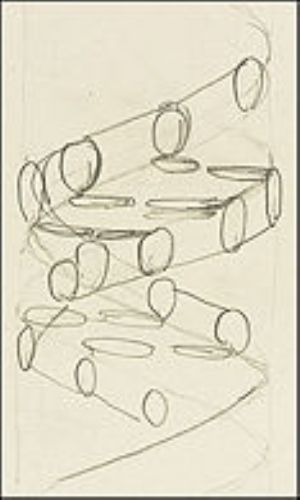
佛朗西斯·克里克所绘,最早的DNA双螺旋草图。 参见:分子生物学史
最早分离出DNA的弗雷德里希·米歇尔是一名瑞士医生,他在1869年,从废弃绷带里所残留的脓液中,发现一些只有显微镜可观察的物质。由于这些物质位于细胞核中,因此米歇尔称之为“核素”(nuclein)[2]。到了1919年,菲巴斯·利文进一步辨识出组成DNA的碱基、糖类以及磷酸核苷酸单元[3],他认为DNA可能是许多核苷酸经由磷酸基团的联结,而串联在一起。不过他所提出概念中,DNA长链较短,且其中的碱基是以固定顺序重复排列。1937年,威廉·阿斯特伯里完成了第一张X光衍射图,阐明了DNA结构的规律性[4]。
1928年,弗雷德里克·格里菲斯从格里菲斯实验中发现,平滑型的肺炎球菌,能转变成为粗糙型的同种细菌,方法是将已死的平滑型与粗糙型活体混合在一起。这种现象称为“转型”。但造成此现象的因子,也就是DNA,是直到1943年,才由奥斯瓦尔德·埃弗里等人所辨识出来[5]。1953年,阿弗雷德·赫希与玛莎·蔡斯确认了DNA的遗传功能,他们在赫希-蔡斯实验中发现,DNA是T2噬菌体的遗传物质[6]。

剑桥大学里一面纪念克里克与DNA结构的彩绘窗。
到了1953年,当时在卡文迪许实验室的詹姆斯·沃森与佛朗西斯·克里克,依据伦敦国王学院的罗莎琳·富兰克林所拍摄的X光衍射图[7]及相关资料,提出了[7]最早的DNA结构精确模型,并发表于《自然》期刊[8]。五篇关于此模型的实验证据论文,也同时以同一主题发表于《自然》[9]。其中包括富兰克林与雷蒙·葛斯林的论文[10],此文所附带的X光衍射图[11],是沃森与克里克阐明DNA结构的关键证据。此外莫里斯·威尔金斯团队也是同期论文的发表者之一[12]。富兰克林与葛斯林随后又提出了A型与B型DNA双螺旋结构之间的差异[13]。1962年,沃森、克里克以及威尔金斯共同获得了诺贝尔生理学或医学奖[14]。
克里克在1957年的一场演说中,提出了分子生物学的中心法则,预测了DNA、RNA以及蛋白质之间的关系,并阐述了“转接子假说”(即后来的tRNA)[15]。1958年,马修·梅瑟生与富兰克林·史达在梅瑟生-史达实验中,确认了DNA的复制机制[16]。后来克里克团队的研究显示,遗传密码是由三个碱基以不重复的方式所组成,称为密码子。这些密码子所构成的遗传密码,最后是由哈尔·葛宾·科拉纳、罗伯特·W·霍利以及马歇尔·沃伦·尼伦伯格解出[17]。为了测出所有人类的DNA序列,人类基因组计划于1990年代展开。到了2001年,多国合作的国际团队与私人企业塞雷拉基因组公司,分别将人类基因组序列草图发表于《自然》[18]与《科学》[19]两份期刊。
物理与化学性质

DNA片段结构动画,各种碱基水平排列于两条螺旋长链之间。放大观看[29]
两股DNA长链会以右旋方式相互缠绕成双螺旋结构,由于以磷酸联结而成的骨架位于外部,且两股之间会留下一些空隙,因此位于螺旋内部的碱基,即使从螺旋外侧依然可见(如右方动画)。双螺旋的表面有两种凹槽(或称“沟”):较大的宽22埃;较小的宽12埃[30]。由于各个碱基靠近大凹槽的一面较容易与外界接触,因此如转录因子等能够与特定序列结合的蛋白质与碱基接触时,通常是作用在靠近大凹槽的一面[31]。
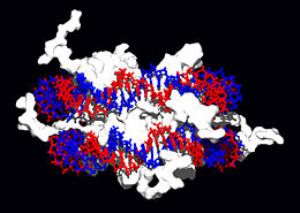

DNA与组织蛋白(上图白色部分)的交互作用,这种蛋白质中的碱性氨基酸(左下蓝色),可与DNA上的酸性磷酸基团结合(右下红色)。
结构蛋白可与DNA结合,是非专一性DNA-蛋白质交互作用的常见例子。染色体中的结构蛋白与DNA组合成复合物,使DNA组织成紧密结实的染色质构造。对真核生物来说,染色质是由DNA与一种称为组织蛋白的小型碱性蛋白质所组合而成;而原核生物体内的此种结构,则掺杂了多种类型的蛋白质[90][91]。双股DNA可在组织蛋白的表面上附着并缠绕整整两圈,以形成一种称为核小体的盘状复合物。组织蛋白里的碱性残基,与DNA上的酸性糖磷酸骨架之间可形成离子键,使两者发生非专一性交互作用,也使复合物中的碱基序列相互分离[92]。在碱性氨基酸残基上所发生的化学修饰有甲基化、磷酸化与乙酰化等[93],这些化学作用可使DNA与组织蛋白之间的作用强度发生变化,进而使DNA与转录因子接触的难易度改变,影响转录作用的速率[94]。其他位于染色体内的非专一性DNA结合蛋白,还包括一种能优先与DNA结合,并使其扭曲的高移动性群蛋白[95]。这类蛋白质可以改变核小体的排列方式,产生更复杂的染色质结构[96]。
DNA结合蛋白中有一种专门与单股DNA结合的类型,称为单股DNA结合蛋白。人类的复制蛋白A是此类蛋白中获得较多研究的成员,作用于多数与解开双螺旋有关的过程,包括DNA复制、重组以及DNA修复[97]。这类结合蛋白可固定单股DNA,使其变得较为稳定,以避免形成茎环(stem-loop),或是因为核酸酶的作用而水解。

λ抑制子是一类具螺旋-转角-螺旋结构的转录因子,可与DNA目标结合[98]。
相对而言,其他的蛋白质则只能与特定的DNA序列进行专一性结合。大多数关于此类蛋白质的研究集中于各种可调控转录作用的转录因子。这类蛋白质中的每一种,都能与特定的DNA序列结合,进而活化或抑制位于启动子附近序列的基因转录作用。转录因子有两种作用方式,第一种可以直接或经由其他中介蛋白质的作用,而与负责转录的RNA聚合酶结合,再使聚合酶与启动子结合,并开启转录作用[99]。第二种则与专门修饰组织蛋白的酵素结合于启动子上,使DNA模板与聚合酶发生接触的难度改变[100]。
由于目标DNA可能散布在生物体中的整个基因组中,因此改变一种转录因子的活性可能会影响许多基因的运作[101]。这些转录因子也因此经常成为信号传递过程中的作用目标,也就是作为细胞反映环境改变,或是进行分化和发育时的媒介。具专一性的转录因子会与DNA发生交互作用,使DNA碱基的周围产生许多接触点,让其他蛋白质得以“读取”这些DNA序列。多数的碱基交互作用发生在大凹槽,也就是最容易从外界接触碱基的部位[102]。

限制酶EcoRV(绿色)与其受质DNA形成复合物[103]。
DNA修饰酵素
核酸酶与连接酶
核酸酶是一种可经由催化磷酸双酯键的水解,而将DNA链切断的酵素。其中一种称为外切酶,可水解位于DNA长链末端的核苷酸;另一种则是内切酶,作用于DNA两个端点之间的位置。在分子生物学领域中使用频率最高的核酸酶为限制内切酶,可切割特定的DNA序列。例如左图中的EcoRV可辨识出具有6个碱基的5′-GAT|ATC-3′序列,并从GAT与ATC之间那条垂直线所在的位置将其切断。此类酵素在自然界中能消化噬菌体DNA,以保护遭受噬菌体感染的细菌,此作用属于限制修饰系统的一部分[104]。在技术上,对序列具专一性的核酸酶可应用于分子选殖与DNA指纹分析。
另一种酵素DNA连接酶,则可利用来自腺苷三磷酸或烟酰胺腺嘌呤二核苷酸的能量,将断裂的DNA长链重新接合[105]。连接酶对于DNA复制过程中产生的延迟股而言尤其重要,这些位于复制叉上的短小片段,可在此酵素作用下黏合成为DNA模板的完整复制品。此外连接酶也参与了DNA修复与遗传重组作用[105]。
拓扑异构酶与螺旋酶
拓扑异构酶是一种同时具有核酸酶与连接酶效用的酵素,可改变DNA的超螺旋程度。其中有些是先使DNA双螺旋的其中一股切开以形成缺口,让另一股能穿过此缺口,进而减低超螺旋程度,最后再将切开的部位黏合[45]。其他类型则是将两股DNA同时切开,使另一条双股DNA得以通过此缺口,之后再将缺口黏合[106]。拓扑异构酶参与了许多DNA相关作用,例如DNA复制与转录[46]。
螺旋酶是分子马达的一种类型,可利用来自各种核苷三磷酸,尤其是腺苷三磷酸的化学能量,破坏碱基之间的氢键,使DNA双螺旋解开成单股形式[107]。此类酵素参与了大多数关于DNA的作用,且必须接触碱基才能发挥功用。
聚合酶
聚合酶是一种利用核苷三磷酸来合成聚合苷酸链的酵素,方法是将一个核苷酸连接到另一个核苷酸的3'羟基位置,因此所有的聚合酶都是以5'往3'的方向进行合成作用[108]。在此类酵素的活化位置上,核苷三磷酸受质会与单股聚合苷酸模板发生碱基配对,因而使聚合酶能够精确地依据模板,合成出互补的另一股聚合苷酸。聚合酶可依据所能利用的模板类型来做分类。
在DNA复制过程中,依赖DNA模板的DNA聚合酶可合成出DNA序列的复制品。由于此复制过程的精确性是生命维持所必需,因此许多这类聚合酶拥有校正功能,可辨识出合成反应中偶然发生的配置错误,也就是一些无法与另一股配对的碱基。检测出错误之后,其3'到5'方向的外切酶活性会发生作用,并将错误的碱基移除[109]。大多数生物体内的DNA聚合酶,是以称为复制体的大型复合物形式来发生作用,此复合物中含有许多附加的次单位,如DNA夹或螺旋酶[110]。
依赖RNA作为模板的DNA聚合酶是一种较特别的聚合酶,可将RNA长链的序列复制成DNA版本。其中包括一种称为逆转录酶的病毒酵素,此种酵素参与了逆转录病毒对细胞的感染过程;另外还有复制端粒所需的端粒酶[111][59],本身结构中含有RNA模板[60]。
转录作用是由依赖DNA作为合成模板的RNA聚合酶来进行,此类酵素可将DNA长链上的序列复制成RNA版本。为了起始一个基因的转录,RNA聚合酶会先与一段称为启动子的DNA序列结合,并使两股DNA分离,再将基因序列复制成信使RNA,直到到达能使转录结束的终止子序列为止。如同人类体内依赖DNA模板的DNA聚合酶,负责转录人类基因组中大多数基因的RNA聚合酶II,也是大型蛋白质复合物的一部分,此复合物受到多重调控,也含有许多附加的次单位[112]。
遗传重组


遗传重组过程中产生的Holliday交叉结构,图中的红色、蓝色、绿色与黄色分别表示四条不同的DNA长链[113]。 参见:遗传重组

重组过程中,两条染色体(M与F)断裂之后又重新接合,产生两条重新排列过的染色体(C1与C2)。
各条DNA螺旋间的交互作用不常发生,在人类细胞核里的每个染色体,各自拥有一块称作“染色体领域”的区域[114]。染色体之间在物理上的分离,对于维持DNA资讯储藏功能的稳定性而言相当重要。
不过染色体之间有时也会发生重组,在重组的过程中,会进行染色体互换:首先两条DNA螺旋会先断裂,之后交换其片段,最后再重新黏合。重组作用使染色体得以互相交换遗传讯息,并产生新的基因组合,进而增加自然选择的效果,且可能对蛋白质的演化产生重要影响[115]。遗传重组也参与DNA修复作用,尤其是当细胞中的DNA发生断裂的时候[116]。
同源重组是最常见的染色体互换方式,可发生于两条序列相类似的染色体上。而非同源重组则对细胞具有伤害性,会造成染色体易位与遗传异常。可催化重组反应的酵素,如RAD51[117],称为“重组酶”。重组作用的第一个步骤,是内切酶作用,或是DNA的损坏所造成的DNA双股断裂[118]。重组酶可催化一系列步骤,使两条螺旋结合产生Holliday交叉。其中每条螺旋中的单股DNA,皆与另一条螺旋上与之互补的DNA连结在一起,进而形成一种可于染色体内移动的交叉形构造,造成DNA链的互换。重组反应最后会因为交叉结构的断裂,以及DNA的重新黏合而停止[119]。
DNA生物代谢的演化
DNA所包含的遗传讯息,是所有现代生命机能,以及生物生长与繁殖的基础。不过目前尚未明了在长达四十亿年的生命史中,DNA究竟是何时出现并开始发生作用。有一些科学家认为,早期的生命形态有可能是以RNA作为遗传物质[108][120]。RNA可能在早期细胞代谢中扮演主要角色,一方面可传递遗传讯息;另一方面也可作为核糖酶的一部分,进行催化作用[121]。在古代RNA世界里,核酸同时具有催化与遗传上的功能,而这些分子后来可能演化成为目前以四种核苷酸组成遗传密码的形式,这是因为当碱基种类较少时,复制的精确性会增加;而碱基种类较多时,增加的则是核酸的催化效能。两种可达成不同目的功能最后在四种碱基的情形下达到最合适数量[122]。
不过关于这种古代遗传系统并没有直接证据,且由于DNA在环境中无法存留超过一百万年,在溶液中又会逐渐降解成短小的片段,因此大多数化石中并无DNA可供研究[123]。即使如此,仍有一些声称表示已经获得更古老的DNA,其中一项研究表示,已从存活于2亿5千万年古老的盐类晶体中的细菌分离出DNA[124],但此宣布引起了讨论与争议[125][126]。
技术应用
遗传工程
参见:分子生物学及遗传工程
重组DNA技术在现代生物学与生物化学中受到广泛应用,所谓重组DNA,是指集合其他DNA序列所制成的人造DNA,可以质体或以病毒载体搭载所想要的格式,将DNA转型到生物个体中[127]。经过遗传改造处里之后的生物体,可用来生产重组蛋白质,以供医学研究使用[128],或是于农业上栽种[129][130]。
法医鉴识
参见:遗传指纹分析
法医可利用犯罪现场遗留的血液、精液、皮肤、唾液或毛发中的DNA,来辨识可能的加害人。此过程称为遗传指纹分析或DNA特征测定,此分析方法比较不同人类个体中许多的重复DNA片段的长度,这些DNA片段包括短串联重复序列与小卫星序列等,一般来说是最为可靠的罪犯辨识技术[131]。不过如果犯罪现场遭受多人的DNA污染,那么将会变得较为复杂难解[132]。首先于1984年发展DNA特征测定的人是一名英国遗传学家阿莱克·杰弗里斯[133]。到了1988年,英国的谋杀案嫌犯科林·皮奇福克,成为第一位因DNA特征测定证据而遭定罪者[134]。利用特定类型犯罪者的DNA样本,可建立出数据库,帮助调查者解决一些只从现场采集到DNA样本的旧案件。此外,DNA特征测定也可用来辨识重大灾害中的罹难者[135]。
历史学与人类学
参见:种系发生学及遗传系谱学
由于DNA在经历一段时间后会积聚一些具有遗传能力突变,因此其中所包含的历史讯息,可经由DNA序列的比较,使遗传学家了解生物体的演化历史,也就是种系[136]。这些研究是种系发生学的一部分,也是演化生物学上的有利工具。假如对物种以内范围的DNA序列进行比较,那么群体遗传学家就可得知特定族群的历史。此方法的应用范围可从生态遗传学到人类学,举例而言,DNA证据已被试图用来寻找失踪的以色列十支派[137][138]。DNA也可以用来调查现代家族的亲戚关系,例如建构莎丽·海明斯与托马斯·杰斐逊的后代之间的家族关系,研究方式则与上述的犯罪调查相当类似,因此有时候某些犯罪调查案件之所以能解决,是因为犯罪现场的DNA与犯罪者亲属的DNA相符[139]。
生物资讯学
参见:生物资讯学
生物资讯学影响了DNA序列资料的运用、搜寻与资料挖掘工作,并发展出各种用于储存并搜寻DNA序列的技术,可进一步应用于计算机科学,尤其是字串搜寻算法、机器学习以及数据库理论[140]。字串搜寻或比对算法是从较大的序列或较多的字母中,寻找单一序列或少数字母的出现位置,可发展用来搜寻特定的核苷酸序列[141]。在其他如文本编辑器的应用里,通常可用简单的算法来解决问题,但只有少量可辨识特征的DNA序列,却造成这些算法的运作不良。序列比对则试图辨识出同源序列,并定位出使这些序列产生差异的特定突变位置,其中的多重序列比对技术可用来研究种系发生关系及蛋白质的功能[142]。由整个基因组所构成的资料含有的大量DNA序列,例如人类基因组计划的研究对象。若要将每个染色体上的每个基因,以及负责调控基因的位置都标示出来,会相当困难。DNA序列上具有蛋白质或RNA编码特征的区域,可利用基因识别算法辨识出来,使研究者得以在进行实验以前,就预测出生物体内可能表现出来的特殊基因产物[143]。
DNA与电脑
参见:DNA运算
DNA最早在运算上应用,是解决了一个属于NP完全的小型直接汉弥尔顿路径问题[144]。DNA可作为“软件”,将讯息写成核苷酸序列;并以酵素或其他分子作为“硬件”进行读取或修饰。举例来说,作为硬件的限制酶FokI可以搭载一段具有软件功能的GGATG序列DNA,再以其他的DNA片段进行输入,并与软硬件复合物产生反应,最后输出另一段DNA[145]。这种类似图灵机的装置可应用于药物治疗。此外DNA运算在能源消耗、空间需求以及效率上优于电子电脑,且DNA运算为具有高度平行(见平行运算)的计算方式。许多其他问题,包括多种抽象机器的模拟、布尔可满足性问题,以及有界形式的旅行推销员问题,皆曾利用DNA运算做过分析[146]。由于小巧紧密的特性,DNA也成为密码学理论的一部分,尤其在于能够利用DNA有效地建构并使用无法破解的一次性密码本[147]。

自我组装产生的DNA纳米结构。左方为电脑绘图,可见4条由DNA双螺旋产生的交叉。右方为原子力显微镜测得的影像。
DNA与纳米科技
参见:DNA纳米科技
DNA的分子性质,例如自我组装特性,使其可用于某些纳米尺度的建构技术,例如利用DNA作为模板,可导引半导体晶体的生长[148]。或是利用DNA本身,来制成一些特殊结构,例如由DNA长链交叉形成的DNA“瓦片”(tile)[149]或是多面体[150]。此外也可以做出一些可活动的元件,例如纳米机械开关,此机械可经由使DNA在不同的光学异构物(B型与Z型)之间进行转变,而使构形发生变化,导致开关的开启或关闭[151]。还有一种DNA机械含有类似镊子的构造,可加入外来DNA使镊子开合,并排出废物DNA,此时DNA的作用类似“燃料”[152]。DNA所建构出来的装置,也可用来作为上述的DNA运算工具。
参见
遗传性疾病 DNA定序 南方墨点法 DNA微阵列 聚合酶链锁反应
参考文献
- Matt Ridley。蔡承志、许优优译。《23对染色体》(Genome)。商周出版。2000年。ISBN 957-667-678-9
- Dahm R (2005). "Friedrich Miescher and the discovery of DNA". Dev Biol 278 (2): 274–88. PMID 15680349.
- Levene P, (1919). "The structure of yeast nucleic acid". J Biol Chem 40 (2): 415–24.
- Astbury W, (1947). "Nucleic acid". Symp. SOC. Exp. Bbl 1 (66).
- Avery O, MacLeod C, McCarty M (1944). "Studies on the chemical nature of the substance inducing transformation of pneumococcal types. Inductions of transformation by a desoxyribonucleic acid fraction isolated from pneumococcus type III". J Exp Med 79 (2): 137–158.
- Hershey A, Chase M (1952). "Independent functions of viral protein and nucleic acid in growth of bacteriophage". J Gen Physiol 36 (1): 39–56. PMID 12981234.
- Watson J.D. and Crick F.H.C. "A Structure for Deoxyribose Nucleic Acid". (PDF) Nature 171, 737–738 (1953). Accessed 13 Feb 2007.
- Watson J, Crick F (1953). "Molecular structure of nucleic acids; a structure for deoxyribose nucleic acid". Nature 171 (4356): 737 – 8. PMID 13054692.
- Nature Archives Double Helix of DNA: 50 Years
- Molecular Configuration in Sodium Thymonucleate. Franklin R. and Gosling R.G.Nature 171, 740–741 (1953)Nature Archives Full Text (PDF)
- Original X-ray diffraction image
- Molecular Structure of Deoxypentose Nucleic Acids. Wilkins M.H.F., A.R. Stokes A.R. & Wilson, H.R. Nature 171, 738–740 (1953)Nature Archives (PDF)
- Evidence for 2-Chain Helix in Crystalline Structure of Sodium Deoxyribonucleate. Franklin R. and Gosling R.G. Nature 172, 156–157 (1953)Nature Archives, full text (PDF)
- The Nobel Prize in Physiology or Medicine 1962 Nobelprize .org Accessed 22 Dec 06
- Crick, F.H.C. On degenerate templates and the adaptor hypothesis (PDF). genome.wellcome.ac.uk (Lecture, 1955). Accessed 22 Dec 2006
- Meselson M, Stahl F (1958). "The replication of DNA in Escherichia coli". Proc Natl Acad Sci U S A 44 (7): 671–82. PMID 16590258.
- ^ The Nobel Prize in Physiology or Medicine 1968 Nobelprize.org Accessed 22 Dec 06
- International Human Genome Sequencing Consortium (2001). "Initial sequencing and analysis of the human genome.". Nature 409: 860−921.
- Venter, JC, et al (2001). "The sequence of the human genome.". Science 291: 1304−1351.
- Alberts, Bruce; Alexander Johnson, Julian Lewis, Martin Raff, Keith Roberts, and Peter Walters (2002). Molecular Biology of the Cell; Fourth Edition. New York and London: Garland Science. ISBN 0-8153-3218-1.
- Butler, John M. (2001) Forensic DNA Typing "Elsevier". pp. 14 – 15. ISBN 978-0-12-147951-0.
- Mandelkern M, Elias J, Eden D, Crothers D (1981). "The dimensions of DNA in solution". J Mol Biol 152 (1): 153 – 61. PMID 7338906.
- Gregory S, et al. (2006). "The DNA sequence and biological annotation of human chromosome 1". Nature 441 (7091): 315 – 21. PMID 16710414.
- Berg J., Tymoczko J. and Stryer L. (2002) Biochemistry. W. H. Freeman and Company ISBN 0-7167-4955-6
- Abbreviations and Symbols for Nucleic Acids, Polynucleotides and their Constituents IUPAC-IUB Commission on Biochemical Nomenclature (CBN) Accessed 03 Jan 2006
- Ghosh A, Bansal M (2003). "A glossary of DNA structures from A to Z". Acta Crystallogr D Biol Crystallogr 59 (Pt 4): 620 – 6. PMID 12657780.
- Takahashi I, Marmur J. (1963). "Replacement of thymidylic acid by deoxyuridylic acid in the deoxyribonucleic acid of a transducing phage for Bacillus subtilis". Nature 197: 794 – 5. PMID 13980287.
- Agris P (2004). "Decoding the genome: a modified view". Nucleic Acids Res 32 (1): 223 – 38. PMID 14715921.
- 来源:PDB 1D65
- Wing R, Drew H, Takano T, Broka C, Tanaka S, Itakura K, Dickerson R (1980). "Crystal structure analysis of a complete turn of B-DNA". Nature 287 (5784): 755 – 8. PMID 7432492.
- Pabo C, Sauer R. "Protein-DNA recognition". Annu Rev Biochem 53: 293 – 321. PMID 6236744.
- Ponnuswamy P, Gromiha M (1994). "On the conformational stability of oligonucleotide duplexes and tRNA molecules". J Theor Biol 169 (4): 419 – 32. PMID 7526075.
- Clausen-Schaumann H, Rief M, Tolksdorf C, Gaub H (2000). "Mechanical stability of single DNA molecules". Biophys J 78 (4): 1997 – 2007. PMID 10733978.
- Chalikian T, Völker J, Plum G, Breslauer K (1999). "A more unified picture for the thermodynamics of nucleic acid duplex melting: a characterization by calorimetric and volumetric techniques". Proc Natl Acad Sci U S A 96 (14): 7853 – 8. PMID 10393911.
- deHaseth P, Helmann J (1995). "Open complex formation by Escherichia coli RNA polymerase: the mechanism of polymerase-induced strand separation of double helical DNA". Mol Microbiol 16 (5): 817 – 24. PMID 7476180.
- Isaksson J, Acharya S, Barman J, Cheruku P, Chattopadhyaya J (2004). "Single-stranded adenine-rich DNA and RNA retain structural characteristics of their respective double-stranded conformations and show directional differences in stacking pattern". Biochemistry 43 (51): 15996 – 6010. PMID 15609994.
- Hüttenhofer A, Schattner P, Polacek N (2005). "Non-coding RNAs: hope or hype?". Trends Genet 21 (5): 289 – 97. PMID 15851066.
- Munroe S (2004). "Diversity of antisense regulation in eukaryotes: multiple mechanisms, emerging patterns". J Cell Biochem 93 (4): 664 – 71. PMID 15389973.
- Makalowska I, Lin C, Makalowski W (2005). "Overlapping genes in vertebrate genomes". Comput Biol Chem 29 (1): 1 – 12. PMID 15680581.
- Johnson Z, Chisholm S (2004). "Properties of overlapping genes are conserved across microbial genomes". Genome Res 14 (11): 2268 – 72. PMID 15520290.
- Lamb R, Horvath C (1991). "Diversity of coding strategies in influenza viruses". Trends Genet 7 (8): 261 – 6. PMID 1771674.
- Davies J, Stanley J (1989). "Geminivirus genes and vectors". Trends Genet 5 (3): 77 – 81. PMID 2660364.
- Berns K (1990). "Parvovirus replication". Microbiol Rev 54 (3): 316 – 29. PMID 2215424.
- Benham C, Mielke S. "DNA mechanics". Annu Rev Biomed Eng 7: 21 – 53. PMID 16004565.
- Champoux J. "DNA topoisomerases: structure, function, and mechanism". Annu Rev Biochem 70: 369 – 413. PMID 11395412.
- Wang J (2002). "Cellular roles of DNA topoisomerases: a molecular perspective". Nat Rev Mol Cell Biol 3 (6): 430 – 40. PMID 12042765.
- Hayashi G, Hagihara M, Nakatani K (2005). "Application of L-DNA as a molecular tag". Nucleic Acids Symp Ser (Oxf) 49: 261 – 262. PMID 17150733.
- Vargason JM, Eichman BF, Ho PS (2000). "The extended and eccentric E-DNA structure induced by cytosine methylation or bromination". Nature Structural Biology 7: 758 – 761. PMID 10966645.
- Wang G, Vasquez KM (2006). "Non-B DNA structure-induced genetic instability". Mutat Res 598 (1 – 2): 103 – 119. PMID 16516932.
- Allemand, et al (1998). "Stretched and overwound DNA forms a Pauling-like structure with exposed bases". PNAS 24: 14152-14157. PMID 9826669.
- Palecek E (1991). "Local supercoil-stabilized DNA structures". Critical Reviews in Biochemistry and Molecular Biology 26 (2): 151 – 226. PMID 1914495.
- Basu H, Feuerstein B, Zarling D, Shafer R, Marton L (1988). "Recognition of Z-RNA and Z-DNA determinants by polyamines in solution: experimental and theoretical studies". J Biomol Struct Dyn 6 (2): 299 – 309. PMID 2482766.
- Leslie AG, Arnott S, Chandrasekaran R, Ratliff RL (1980). "Polymorphism of DNA double helices". J. Mol. Biol. 143 (1): 49–72. PMID 7441761.
- Wahl M, Sundaralingam M (1997). "Crystal structures of A-DNA duplexes". Biopolymers 44 (1): 45 – 63. PMID 9097733.
- Lu XJ, Shakked Z, Olson WK (2000). "A-form conformational motifs in ligand-bound DNA structures". J. Mol. Biol. 300 (4): 819-40. PMID 10891271.
- Rothenburg S, Koch-Nolte F, Haag F. "DNA methylation and Z-DNA formation as mediators of quantitative differences in the expression of alleles". Immunol Rev 184: 286 – 98. PMID 12086319.
- Oh D, Kim Y, Rich A (2002). "Z-DNA-binding proteins can act as potent effectors of gene expression in vivo". Proc. Natl. Acad. Sci. U.S.A. 99 (26): 16666-71. PMID 12486233.
- 来自NDB UD0017
- Greider C, Blackburn E (1985). "Identification of a specific telomere terminal transferase activity in Tetrahymena extracts". Cell 43 (2 Pt 1): 405 – 13. PMID 3907856.
- 60.0 60.1 60.2 Nugent C, Lundblad V (1998). "The telomerase reverse transcriptase: components and regulation". Genes Dev 12 (8): 1073 – 85. PMID 9553037.
- Wright W, Tesmer V, Huffman K, Levene S, Shay J (1997). "Normal human chromosomes have long G-rich telomeric overhangs at one end". Genes Dev 11 (21): 2801 – 9. PMID 9353250.
- Burge S, Parkinson G, Hazel P, Todd A, Neidle S (2006). "Quadruplex DNA: sequence, topology and structure". Nucleic Acids Res 34 (19): 5402 – 15. PMID 17012276.
- Parkinson G, Lee M, Neidle S (2002). "Crystal structure of parallel quadruplexes from human telomeric DNA". Nature 417 (6891): 876 – 80. PMID 12050675.
- Griffith J, Comeau L, Rosenfield S, Stansel R, Bianchi A, Moss H, de Lange T (1999). "Mammalian telomeres end in a large duplex loop". Cell 97 (4): 503 – 14. PMID 10338214.
- Klose R, Bird A (2006). "Genomic DNA methylation: the mark and its mediators". Trends Biochem Sci 31 (2): 89–97. PMID 16403636.
- Bird A (2002). "DNA methylation patterns and epigenetic memory". Genes Dev 16 (1): 6–21. PMID 11782440.
- Walsh C, Xu G. "Cytosine methylation and DNA repair". Curr Top Microbiol Immunol 301: 283–315. PMID 16570853.
- Ratel D, Ravanat J, Berger F, Wion D (2006). "N6-methyladenine: the other methylated base of DNA". Bioessays 28 (3): 309–15. PMID 16479578.
- Gommers-Ampt J, Van Leeuwen F, de Beer A, Vliegenthart J, Dizdaroglu M, Kowalak J, Crain P, Borst P (1993). "beta-D-glucosyl-hydroxymethyluracil: a novel modified base present in the DNA of the parasitic protozoan T. brucei". Cell 75 (6): 1129–36. PMID 8261512.
- 来源:PDB 1JDG
- Douki T, Reynaud-Angelin A, Cadet J, Sage E (2003). "Bipyrimidine photoproducts rather than oxidative lesions are the main type of DNA damage involved in the genotoxic effect of solar UVA radiation". Biochemistry 42 (30): 9221–6. PMID 12885257. ,
- Cadet J, Delatour T, Douki T, Gasparutto D, Pouget J, Ravanat J, Sauvaigo S (1999). "Hydroxyl radicals and DNA base damage". Mutat Res 424 (1–2): 9–21. PMID 10064846.
- Shigenaga M, Gimeno C, Ames B (1989). "Urinary 8-hydroxy-2′-deoxyguanosine as a biological marker of in vivo oxidative DNA damage". Proc Natl Acad Sci U S A 86 (24): 9697–701. PMID 2602371.
- Cathcart R, Schwiers E, Saul R, Ames B (1984). "Thymine glycol and thymidine glycol in human and rat urine: a possible assay for oxidative DNA damage". Proc Natl Acad Sci U S A 81 (18): 5633–7. PMID 6592579.
- Valerie K, Povirk L (2003). "Regulation and mechanisms of mammalian double-strand break repair". Oncogene 22 (37): 5792–812. PMID 12947387.
- Ferguson L, Denny W (1991). "The genetic toxicology of acridines". Mutat Res 258 (2): 123–60. PMID 1881402.
- Jeffrey A (1985). "DNA modification by chemical carcinogens". Pharmacol Ther 28 (2): 237–72. PMID 3936066.
- Stephens T, Bunde C, Fillmore B (2000). "Mechanism of action in thalidomide teratogenesis". Biochem Pharmacol 59 (12): 1489–99. PMID 10799645.
- Braña M, Cacho M, Gradillas A, de Pascual-Teresa B, Ramos A (2001). "Intercalators as anticancer drugs". Curr Pharm Des 7 (17): 1745–80. PMID 11562309.
- Venter J, et al. (2001). "The sequence of the human genome". Science 291 (5507): 1304–51. PMID 11181995.
- Thanbichler M, Wang S, Shapiro L (2005). "The bacterial nucleoid: a highly organized and dynamic structure". J Cell Biochem 96 (3): 506–21. PMID 15988757.
- Wolfsberg T, McEntyre J, Schuler G (2001). "Guide to the draft human genome". Nature 409 (6822): 824–6. PMID 11236998.
- Gregory T (2005). "The C-value enigma in plants and animals: a review of parallels and an appeal for partnership". Ann Bot (Lond) 95 (1): 133–46. PMID 15596463.
- The ENCODE Project Consortium (2007). "Identification and analysis of functional elements in 1% of the human genome by the ENCODE pilot project". Nature 447 (7146): 799-816. doi:doi:10.1038/nature05874.
- 来源:PDB 1MSW
- Pidoux A, Allshire R (2005). "The role of heterochromatin in centromere function". Philos Trans R Soc Lond B Biol Sci 360 (1455): 569–79. PMID 15905142.
- Harrison P, Hegyi H, Balasubramanian S, Luscombe N, Bertone P, Echols N, Johnson T, Gerstein M (2002). "Molecular fossils in the human genome: identification and analysis of the pseudogenes in chromosomes 21 and 22". Genome Res 12 (2): 272–80. PMID 11827946.
- Harrison P, Gerstein M (2002). "Studying genomes through the aeons: protein families, pseudogenes and proteome evolution". J Mol Biol 318 (5): 1155–74. PMID 12083509.
- Albà M (2001). "Replicative DNA polymerases". Genome Biol 2 (1): REVIEWS3002. PMID 11178285.
- Sandman K, Pereira S, Reeve J (1998). "Diversity of prokaryotic chromosomal proteins and the origin of the nucleosome". Cell Mol Life Sci 54 (12): 1350–64. PMID 9893710.
- Dame RT (2005). "The role of nucleoid-associated proteins in the organization and compaction of bacterial chromatin". Mol. Microbiol. 56 (4): 858-70. PMID 15853876.
- Luger K, Mäder A, Richmond R, Sargent D, Richmond T (1997). "Crystal structure of the nucleosome core particle at 2.8 A resolution". Nature 389 (6648): 251–60. PMID 9305837.
- ^ Jenuwein T, Allis C (2001). "Translating the histone code". Science 293 (5532): 1074–80. PMID 11498575.
- Ito T. "Nucleosome assembly and remodelling". Curr Top Microbiol Immunol 274: 1–22. PMID 12596902.
- Thomas J (2001). "HMG1 and 2: architectural DNA-binding proteins". Biochem Soc Trans 29 (Pt 4): 395–401. PMID 11497996.
- Grosschedl R, Giese K, Pagel J (1994). "HMG domain proteins: architectural elements in the assembly of nucleoprotein structures". Trends Genet 10 (3): 94–100. PMID 8178371.
- Iftode C, Daniely Y, Borowiec J (1999). "Replication protein A (RPA): the eukaryotic SSB". Crit Rev Biochem Mol Biol 34 (3): 141–80. PMID 10473346.
- 来源:PDB 1LMB
- Myers L, Kornberg R. "Mediator of transcriptional regulation". Annu Rev Biochem 69: 729–49. PMID 10966474.
- Spiegelman B, Heinrich R (2004). "Biological control through regulated transcriptional coactivators". Cell 119 (2): 157-67. PMID 15479634.
- Li Z, Van Calcar S, Qu C, Cavenee W, Zhang M, Ren B (2003). "A global transcriptional regulatory role for c-Myc in Burkitt's lymphoma cells". Proc Natl Acad Sci U S A 100 (14): 8164–9. PMID 12808131.
- Pabo C, Sauer R. "Protein-DNA recognition". Annu Rev Biochem 53: 293–321. PMID 6236744.
- Created from PDB 1RVA
- Bickle T, Krüger D (1993). "Biology of DNA restriction". Microbiol Rev 57 (2): 434–50. PMID 8336674.
- 105.0 105.1 Doherty A, Suh S (2000). "Structural and mechanistic conservation in DNA ligases.". Nucleic Acids Res 28 (21): 4051–8. PMID 11058099.
- Schoeffler A, Berger J (2005). "Recent advances in understanding structure-function relationships in the type II topoisomerase mechanism". Biochem Soc Trans 33 (Pt 6): 1465–70. PMID 16246147.
- Tuteja N, Tuteja R (2004). "Unraveling DNA helicases. Motif, structure, mechanism and function". Eur J Biochem 271 (10): 1849–63. PMID 15128295.
- 108.0 108.1 Joyce C, Steitz T (1995). "Polymerase structures and function: variations on a theme?". J Bacteriol 177 (22): 6321–9. PMID 7592405.
- Hubscher U, Maga G, Spadari S. "Eukaryotic DNA polymerases". Annu Rev Biochem 71: 133–63. PMID 12045093.
- Johnson A, O'Donnell M. "Cellular DNA replicases: components and dynamics at the replication fork". Annu Rev Biochem 74: 283–315. PMID 15952889.
- Tarrago-Litvak L, Andréola M, Nevinsky G, Sarih-Cottin L, Litvak S (1994). "The reverse transcriptase of HIV-1: from enzymology to therapeutic intervention". FASEB J 8 (8): 497–503. PMID 7514143.
- Martinez E (2002). "Multi-protein complexes in eukaryotic gene transcription". Plant Mol Biol 50 (6): 925–47. PMID 12516863.
- 来源:PDB 1M6G
- Cremer T, Cremer C (2001). "Chromosome territories, nuclear architecture and gene regulation in mammalian cells". Nat Rev Genet 2 (4): 292–301. PMID 11283701.
- Pál C, Papp B, Lercher M (2006). "An integrated view of protein evolution". Nat Rev Genet 7 (5): 337–48. PMID 16619049.
- O'Driscoll M, Jeggo P (2006). "The role of double-strand break repair - insights from human genetics". Nat Rev Genet 7 (1): 45–54. PMID 16369571.
- Vispé S, Defais M (1997). "Mammalian Rad51 protein: a RecA homologue with pleiotropic functions". Biochimie 79 (9-10): 587-92. PMID 9466696.
- Neale MJ, Keeney S (2006). "Clarifying the mechanics of DNA strand exchange in meiotic recombination". Nature 442 (7099): 153-8. PMID 16838012.
- Dickman M, Ingleston S, Sedelnikova S, Rafferty J, Lloyd R, Grasby J, Hornby D (2002). "The RuvABC resolvasome". Eur J Biochem 269 (22): 5492–501. PMID 12423347.
- Orgel L. "Prebiotic chemistry and the origin of the RNA world". Crit Rev Biochem Mol Biol 39 (2): 99–123. PMID 15217990.
- Davenport R (2001). "Ribozymes. Making copies in the RNA world". Science 292 (5520): 1278. PMID 11360970.
- Szathmáry E (1992). "What is the optimum size for the genetic alphabet?". Proc Natl Acad Sci U S A 89 (7): 2614–8. PMID 1372984.
- Lindahl T (1993). "Instability and decay of the primary structure of DNA". Nature 362 (6422): 709–15. PMID 8469282.
- Vreeland R, Rosenzweig W, Powers D (2000). "Isolation of a 250 million-year-old halotolerant bacterium from a primary salt crystal". Nature 407 (6806): 897–900. PMID 11057666.
- Hebsgaard M, Phillips M, Willerslev E (2005). "Geologically ancient DNA: fact or artefact?". Trends Microbiol 13 (5): 212–20. PMID 15866038.
- Nickle D, Learn G, Rain M, Mullins J, Mittler J (2002). "Curiously modern DNA for a "250 million-year-old" bacterium". J Mol Evol 54 (1): 134–7. PMID 11734907.
- Goff SP, Berg P (1976). "Construction of hybrid viruses containing SV40 and lambda phage DNA segments and their propagation in cultured monkey cells". Cell 9 (4 PT 2): 695–705. PMID 189942.
- Houdebine L. "Transgenic animal models in biomedical research". Methods Mol Biol 360: 163–202. PMID 17172731.
- Daniell H, Dhingra A (2002). "Multigene engineering: dawn of an exciting new era in biotechnology". Curr Opin Biotechnol 13 (2): 136–41. PMID 11950565.
- Job D (2002). "Plant biotechnology in agriculture". Biochimie 84 (11): 1105–10. PMID 12595138.
- Collins A, Morton N (1994). "Likelihood ratios for DNA identification". Proc Natl Acad Sci U S A 91 (13): 6007–11. PMID 8016106.
- Weir B, Triggs C, Starling L, Stowell L, Walsh K, Buckleton J (1997). "Interpreting DNA mixtures". J Forensic Sci 42 (2): 213–22. PMID 9068179.
- Jeffreys A, Wilson V, Thein S. "Individual-specific 'fingerprints' of human DNA.". Nature 316 (6023): 76–9. PMID 2989708.
- Colin Pitchfork — first murder conviction on DNA evidence also clears the prime suspect Forensic Science Service Accessed 23 Dec 2006
- DNA Identification in Mass Fatality Incidents. National Institute of Justice (September 2006).
- Wray G (2002). "Dating branches on the tree of life using DNA". Genome Biol 3 (1): REVIEWS0001. PMID 11806830.
- Lost Tribes of Israel, NOVA, PBS airdate: 22 February 2000. Transcript available from PBS.org, (last accessed on 4 March 2006)
- Kleiman, Yaakov. "The Cohanim/DNA Connection: The fascinating story of how DNA studies confirm an ancient biblical tradition". aish.com (January 13, 2000). Accessed 4 March 2006.
- Bhattacharya, Shaoni. "Killer convicted thanks to relative's DNA". newscientist.com (20 April 2004). Accessed 22 Dec 06
- Baldi, Pierre. Brunak, Soren. Bioinformatics: The Machine Learning Approach MIT Press (2001) ISBN 978-0-262-02506-5
- Gusfield, Dan. Algorithms on Strings, Trees, and Sequences: Computer Science and Computational Biology. Cambridge University Press, 15 January 1997. ISBN 978-0-521-58519-4.
- Sjölander K (2004). "Phylogenomic inference of protein molecular function: advances and challenges". Bioinformatics 20 (2): 170-9. PMID 14734307.
- Mount DM (2004). Bioinformatics: Sequence and Genome Analysis, 2, Cold Spring Harbor Laboratory Press.
- Adleman L (1994). "Molecular computation of solutions to combinatorial problems". Science 266 (5187): 1021–4. PMID 7973651.
- Benenson Y, Paz-Elizur T, Adar R, Keinan E, Livneh Z, Shapiro E (2001). "Programmable and autonomous computingmachine made of biomolecules". Nature 414: 430–434.
- Parker J (2003). "Computing with DNA.". EMBO Rep 4 (1): 7–10. PMID 12524509.
- Ashish Gehani, Thomas LaBean and John Reif. DNA-Based Cryptography. Proceedings of the 5th DIMACS Workshop on DNA Based Computers, Cambridge, MA, USA, 14–15 June 1999.
- Coffer, J. L. et al. (1996). "Dictation of the shape of mesoscale semiconductor nanoparticle assemblies by plasmid DNA". Appl. Phys. Lett. 69: 3851–3853.
- Strong M (2004). "Protein Nanomachines". PLoS Biology 2: e73.
- Chen J, Seeman NC (1991). "Synthesis from DNA of a molecule with the connectivity of a cube". Nature 350: 631–633.
- Mao C, Sun W, Shen Z, Seeman NC (1999). "A nanomechanical device based on the B-Z transition of DNA". Nature 397: 144–146.
- Bernard Yurke, Andrew J. Turberfield, Allen P. Mills, Jr, Friedrich C. Simmel and Jennifer L. Neumann (2000). "A DNA-Fuelled Molecular Machine Made of DNA". Nature 406: 605–608.
延伸阅读
- (中文) 林正焜、洪火树《认识DNA:下一波的医疗革命》。商周出版,2005年。ISBN 986-124-428-X
- (中文) Karl Drlica。周业仁译。《DNA的14堂课》(Understanding DNA and Gene Cloning)。天下文化,2002年。ISBN 986-417-077-5
- (中文) James D. Watson。陈正萱、张项译。《双螺旋─DNA结构发现者的青春告白》(The Double Helix)。时报出版,1998年。ISBN 957-132-617-8
- (英文) Clayton, Julie. (Ed.). 50 Years of DNA, Palgrave MacMillan Press, 2003. ISBN 978-1-40-391479-8
- (英文) Judson, Horace Freeland. The Eighth Day of Creation: Makers of the Revolution in Biology, Cold Spring Harbor Laboratory Press, 1996. ISBN 978-0-87-969478-4
- (英文) Olby, Robert. The Path to The Double Helix: Discovery of DNA, first published in October 1974 by MacMillan, with foreword by Francis Crick; ISBN 978-0-48-668117-7; the definitive DNA textbook, revised in 1994, with a 9 page postscript.
- (英文) Ridley, Matt. Francis Crick: Discoverer of the Genetic Code (Eminent Lives) HarperCollins Publishers; 192 pp, ISBN 978-0-06-082333-7 2006
- (英文) Rose, Steven. The Chemistry of Life, Penguin, ISBN 978-0-14-027273-4.
- (英文) Watson, James D. and Francis H.C. Crick. A structure for Deoxyribose Nucleic Acid (PDF). Nature 171, 737–738, 25 April 1953.
- (英文) Watson, James D. DNA: The Secret of Life ISBN 978-0-375-41546-3.
- (英文) Watson, James D. The Double Helix: A Personal Account of the Discovery of the Structure of DNA (Norton Critical Editions). ISBN 978-0-393-95075-5
- (英文) Watson, James D. "Avoid boring people and other lessons from a life in science" New York: Random House. ISBN 978-0-375-421844
- (英文) Calladine, Chris R.; Drew, Horace R.; Luisi, Ben F. and Travers, Andrew A. Understanding DNA, Elsevier Academic Press, 2003. ISBN 978-0-12155089-9
外部链接
- (中文) 核酸 - 生物化学教学网页
- (中文) 画说DNA - DNA from the beginning中文版,以动画介绍DNA
- (英文) DNA Interactive - Flash交互式介绍
- (英文) DNA from the beginning
- (英文) The Register of Francis Crick Personal Papers - 佛朗西斯·克里克的文章
- (英文) Double Helix 1953–2003 英国国家生物技术教育中心
- (英文) Double helix: 50 years of DNA, Nature
- (英文) Rosalind Franklin's contributions to the study of DNA
- (英文) U.S. National DNA Day - DNA日
- (英文) Genetic Education Modules for Teachers - DNA from the Beginning学习指导
- (英文) Listen to Francis Crick and James Watson talking on the BBC in 1962, 1972, and 1974
- (英文) DNA under electron microscope
- (英文) DNA Articles - 论文与讯息收集
- (英文) DNA coiling to form chromosomes
- (英文) DISPLAR: DNA binding site prediction on protein
- (英文) Dolan DNA Learning Center
- (英文) Olby, R. (2003) "Quiet debut for the double helix" Nature 421 (January 23): 402–405.
- (英文) Basic animated guide to DNA cloning
- (英文) DNA the Double Helix Game - 诺贝尔奖官方网站
来源
本文来自维基百科